Greenhouse gas (GHG) accounting and deforestation-and-conversion-free (DCF) supply chain work have been treated as separate agendas for too long. Frameworks are converging, but company data, methodology, and operational setups often still prevent the two from working as one. Across commodities, the overlap is large because land use change is a major driver of Scope 3 emissions, and DCF commitments are increasingly central to climate targets.
This article builds on a panel co-hosted by Meridia and AdAstra Sustainability, where sustainability experts explored how companies can practically align DCF commitments with land use change emissions accounting in global supply chains.
Why the intersection matters
Land use change is a material part of corporate emissions footprints across supply chains.
For some companies more than 80% of emissions depend on land use change, while others report roughly 30% of total GHG emissions coming from land use change across raw materials.
This makes land use change one of the largest levers for reducing Scope 3 emissions and meeting climate pledges validated under science-based target approaches.
How companies connect DCF and climate targets in practice
1. Aligning DCF programs to land use change emission targets
A DCF agenda can be designed to deliver land use change emissions targets when climate and deforestation teams work together.
Key operational elements include:
- Joint work between climate action teams and deforestation teams
- Prioritisation of hotspots based on quantified land use change emissions
- Use of landscape initiatives to address issues beyond individual farms
2. Moving beyond avoidance
Avoidance alone is not sufficient. A DCF program can reduce risk, but it does not automatically deliver the full emissions reductions needed.
Necessary mitigation actions alongside DCF include:
- Working with farmers on yield improvements
- Supporting livelihoods to avoid exclusion and unintended consequences
- Investing beyond compliance to reduce emissions further through land management
3. Verification vs accounting: different purposes, different standards
DCF assurance and GHG accounting are built on different philosophies and risk profiles.
DCF assurance is compliance-driven
DCF monitoring is often used to make business decisions about suppliers and market access. Regulatory risk can be explicit, including the risk of not being able to import products if non-compliant. This drives a need for high confidence and low tolerance for error. At the same time, many DCF commitments are voluntary. In these cases, reputational and investor risk can be just as significant as regulatory risk. Companies have faced public scrutiny, legal complaints, and investor pressure when exposed to sourcing commodities from areas in breach of their own deforestation commitments. Recent investigations and investor actions have shown that unverified or weakly substantiated claims can lead to brand damage, litigation risk, and loss of investor confidence.¹
Land use change emissions accounting is estimate-driven
Land use change emissions accounting aims for a “good enough” estimate to locate hotspots and guide action. It is not binary. It focuses on what happened to CO₂ on land over a longer history, often over multi-decade periods.
Accounting approaches include sector guidance intended to harmonise GHG accounting.
Understanding these differences is critical before attempting to merge the systems.
Farm-level vs jurisdictional approaches
Farm-level direct land use change (dLUC)
When farm polygons are available, direct land use change emissions can be estimated for those farms. This supports comparisons against broader baselines and can strengthen program-level decision-making.
Jurisdictional-level direct land use change (jdLUC)
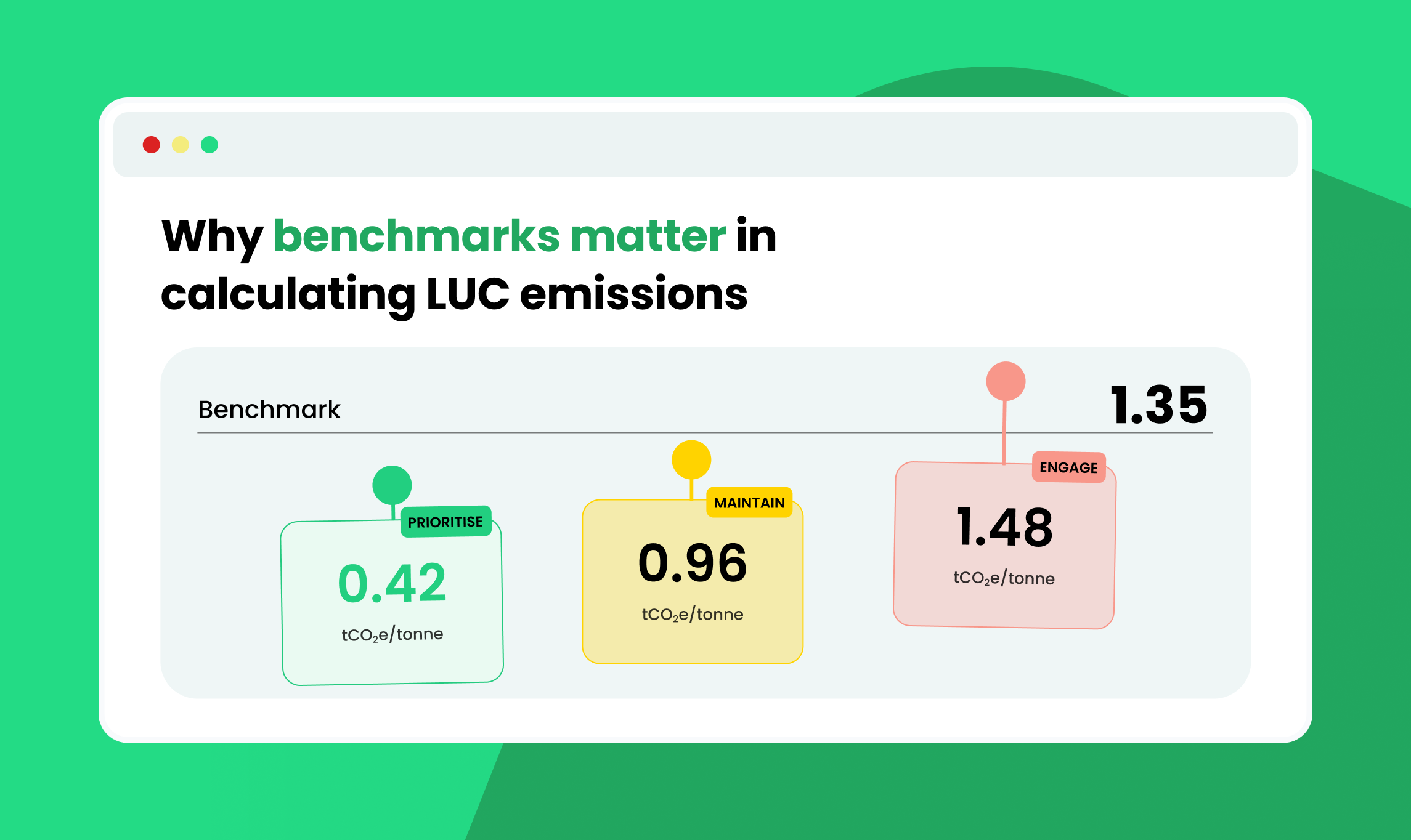
Jurisdictional approaches enable impact estimates even without perfect traceability or any farm location data. The method substitutes missing location data with a production or crop presence layer, using crop maps to identify where action should be prioritised in a supply shed or jurisdiction.
This approach is a way to:
- Prioritise action when traceability is incomplete
- Provide a direct impact estimate for reporting in the absence of farm locations
- Benchmark supply chains against jurisdictional patterns
Jurisdictional approaches are not a substitute for traceability. But they allow progress while traceability systems are currently absent or under development.
Economic feasibility and scaling
Scaling requires collaboration and investment across supply chain actors. Field data collection remains time- and effort-intensive, particularly in remote regions.
Connectivity constraints, farmer time availability, and parallel data requests across sustainability and quality workstreams all create pressure
Approaches to consider:
- Leveraging publicly available tools to get an initial footprint estimate
- Using open data to prioritise where higher-cost bespoke datasets are needed
- Backing commitments with investments, including premiums paid for verified responsible programs
- Combining remote sensing and geospatial methods with on-the-ground understanding of farm practices
“We cannot wait for perfect data to take action.” - Claudia Parra, Ecosystems and Biodiversity Manager, at ofi
Progress must be iterative.
A practical checklist for combining DCF and GHG accounting
Four feasibility questions determine whether DCF commitments can be combined cleanly with GHG accounting:
- What is the cut-off date?
- Which land conversion types are covered? Coverage can differ between DCF commitments and GHG accounting needs.
- Which thresholds are applied? Thresholds used to reduce false positives in DCF monitoring may not make sense for GHG accounting.
- Which frameworks or standards are being followed?
Common reference points include:
- The GHG Protocol and SBTi FLAG guidance for land-related emissions accounting
- The Accountability Framework Initiative (AFi) for deforestation- and conversion-free commitments
A further accounting question remains critical: What happens to impacts not classified as land use change? Do they move into land management emissions or are they disregarded?
Alignment depends on clear answers.
What works going forward
The agenda requires integrated operations and shared learning:
- Bringing climate and deforestation teams together increases the ability to act on synergies.
- Integrated approaches anchored in established best practices and sector guidance improve consistency.
- Collaboration across suppliers, buyers, and technical partners is necessary to fund and implement programs.
- Action cannot wait for perfect traceability or perfect models; prioritisation and mitigation must proceed with available data while improving methods over time.