Indigenous Peoples and Local Communities (IPLCs) are self-identified groups with deep collective relationships to their lands, territories, and surrounding ecosystems. They maintain distinct cultural and governance systems rooted in place-based stewardship, and increasingly, their rights sit at the heart of responsible sourcing.
Despite this, IPLC lands have historically faced encroachment and unsanctioned commercial activity. Today, many national and international legal frameworks recognise and protect these rights. For companies sourcing agricultural commodities globally, that creates both responsibilities and risks: supply chains that intersect with IPLC territories may face legal, reputational, and ethical exposure if suppliers are not aligned with community rights.
What Meridia's IPLC risk assessment does
Meridia's IPLC risk assessment helps companies identify, understand, and mitigate these risks. It has two core objectives: empowering IPLC groups who legitimately produce agricultural goods within their territories, and preventing unlawful occupation or exploitation of protected lands by unauthorised actors, a risk particularly significant in sectors like soy, palm oil, and cattle ranching.
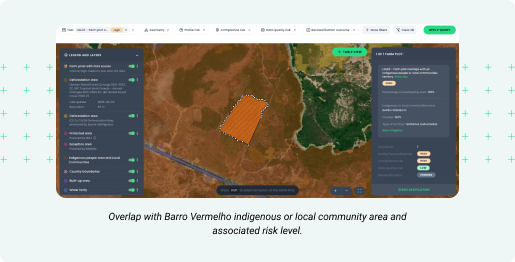
The assessment combines geospatial analysis, regulatory research, and supply chain screening. It starts by mapping IPLC territories using sources such as Landmark and national databases, cross-referenced with country-specific legal frameworks. Those mapped territories are then overlaid with a client's sourcing regions to flag potential overlaps.
Finally, clients receive clear, actionable guidance, such as verifying whether suppliers are members of a recognised community or authorised representatives, or reconsidering sourcing relationships where risks cannot be mitigated.
Case studies: IPLC risk in Brazil
Brazil illustrates how the tool works in practice, given its extensive legal recognition of Indigenous and traditional territories.
Case study 1 - Soy production overlapping with Indigenous territory
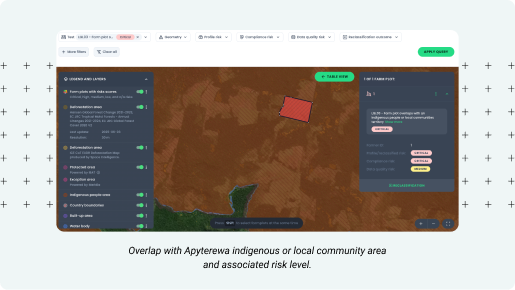
A farm sourcing soy that overlaps with a demarcated Indigenous territory would typically be flagged as a critical risk, since large-scale export agriculture is incompatible with the legal framework governing those areas unless conducted by authorised Indigenous actors. Companies are advised to verify their commercial relationships immediately, if sourcing occurs through a recognised Indigenous association or cooperative, the risk can be mitigated.
Case study 2 - Cacao production overlapping with Afro-descendant territory
A cocoa farm overlapping with Afro-descendant community lands might be classified as high risk, serious, but potentially mitigable if sourcing occurs directly through recognised community associations, cooperatives, or authorised community leaders. If sourcing runs through unrelated third parties, additional due diligence or a reconsideration of the sourcing relationship may be necessary.
Why it matters
As regulatory expectations and sustainability commitments continue to evolve, companies must demonstrate that their sourcing practices respect human rights, land rights, and environmental protections. Meridia's IPLC risk assessment is a practical tool for doing exactly that, reducing legal and reputational exposure while supporting supply chains that respect the rights and livelihoods of Indigenous Peoples and Local Communities.
Want to learn more? Download our guide to IPLC risk assessments.