Quantifying Land Use Change Emissions in Uganda's Coffee Sector

Meridia and AdAstra provided ETG and Lavazza with a granular assessment of direct land use change (dLUC) emissions, revealing a footprint significantly lower than global benchmarks and validating sustainable sourcing efforts.
Clients

Lavazza, ETG

Industry

Coffee

Region

Uganda

Challenge

Accurately calculating direct land use change (dLUC) emissions in a complex supply chain to benchmark performance against global and regional standards.

Solution

A dual-layer approach integrating Meridia Verify for data quality, deforestation assessment and legality assurance and Orbae by AdAstra for high-resolution GHG emission assessment from land use change.

The challenge of assessing farm-plot-level carbon footprints

For global coffee leaders like ETG and Lavazza, understanding the environmental impact of their supply chain is key.

A major component of this impact is direct land use change (dLUC) emissions resulting from converting land (such as forests or grasslands) into cropland. The challenge was to move beyond generic estimates and obtain precise, verifiable data on the dLUC footprint of select coffee plots in Uganda to understand how they compare to other high-risk origins.

Continue reading

Learn how Meridia and AdAstra helped ETG and Lavazza assess direct land use change (LUC) emissions at the farm-plot level in Uganda.

Complete the form to continue reading and discover:

  • The assessment approach
  • Key findings from the assessment
  • Practical insights

Validated farm plot data meets spatially explicit LUC emissions assessment

To address the complexities of farm plot verification and emissions from land use change at the farm-plot level, the project merges two sophisticated solutions, combining Meridia's high-accuracy farm plot verification with AdAstra's Orbae technology for a granularLUC emissions assessment:

Farm-plot-level verification

The foundation of the analysis was built on Meridia Verify, a rigorous data verification engine. Meridia applied over 50 distinct tests to ETG/Lavazza’s field data, covering data quality, deforestation compliance, and traceability. This process ensured that every polygon and farmer record was checked for integrity, consistency, and plausibility, eliminating the risk of using inaccurate data for environmental impact assessment.

LUC emissions assessment

Leveraging the verified farm plots AdAstra utilized its Orbae technology to calculate the land use change emissions of green coffee at field level. Using satellite-based data layers in 30-meter resolution that look back over a 20-year history of the land,AdAstra unveiled specific land conversion dynamics and combined them with spatially-explicit carbon stock estimates. This resulted in high-accuracy dLUC emissions specific to the coffee produced on the farms, replacing data that would otherwise be based on statistical estimates

Clients

Direct LUC emissions lower than typical benchmarks

The analysis yielded highly positive results for the assessed supply chain, finding a lower LUC emissions footprint relative to country averages.

Significantly lower LUC emissions

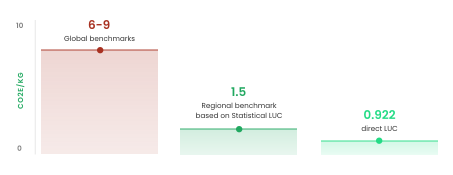
The weighted-average dLUC emission factor for the Ugandan farms was calculated at 0.922 kg CO2e/kg green coffee. This is exceptionally low compared to global benchmarks for high-risk origins, which often range between 6.0 and 9.0 kg CO2e/kg. It is also substantially lower than regional benchmarks for Uganda based on statistical LUC approaches, estimated around 1.5 kg CO2e/kg green coffee.*

Drivers of conversion

The analysis identified that the primary driver of land use change was natural grassland conversion, accounting for 97% of the converted area. Deforestation (forest conversion) was minimal, representing less than 3% of the conversion.

Meridia and AdAstra partnership

The collaboration between Meridia and AdAstra merged verified data with advanced geospatial analytics and GHG accounting to deliver a best-in-class assessment for ETG and Lavazza.

By integrating Meridia’s ability to guarantee clean, compliant input data with AdAstra’s capability to generate state-of-the-art LUC emission metrics, the partnership delivered farm plot level land use change assessment. The results prevent the use of generic and often unrealistic country averages based on coarse statistical information. This synergy provided the clients with a defensible, audit-ready dataset that accurately reflects the specificity of their supply chain.

Moving forward

This project demonstrates the value of supply chain-specific LUC emissions assessments informed by verified farm data.

By combining Meridia’s rigorous verification process with AdAstra’s analytical precision, ETG and Lavazza have gained a scientific basis for validating their sustainability credentials on this part of the supply base. The insights confirm that while the LUC emissions of the assessed plots are not negligible, the coffee cultivated there comes with a significantly lower environmental cost than generally assumed when using statistical data, providing a strong narrative for responsible sourcing.

*Later in 2026, AdAstra will release national and subnational LUC emission factors for coffee in Uganda as open data. The emission factors will be based on their jurisdictional dLUC methodology and grounded in 10-meter resolution. Partner list

While a dLUC assessment can result in a lower carbon footprint, that is not guaranteed to be the case. The opposite may equally be true: A closer look may reveal higher impacts for certain farms than the regional or national average. Either way, our teams can guide you on the best next steps to take given your particular situation.