.png)
CLAP closed in 2025 with more than 8,800 documents delivered and secured for cocoa farmer communities. Among the implementations, the consortium gathers learnings on the land tenure situation in Côte d’Ivoire.
An independent endline evaluation of the Côte d’Ivoire Land Partnership (CLAP) shows a consistent pattern: security and peace of mind come first; economic outcomes take longer.
Conducted by FINCA International’s Research and Data Science team with data collected locally by Audace Institut Afrique, the evaluation looks at how cocoa farmers experience land documentation in practice, after certificates and contracts have been issued.
Land documentation is often expected to unlock economic opportunity. But what actually changes first, once land papers are issued?
How the evidence was generated
After the data collection operated in 2022 for the baseline, the evaluation combines lived experience with quantitative validation:
- 21 focus group discussions and 19 in-depth interviews with land certificate holders, contract holders, family heads, customary leaders, and village land committee members
- AI-enabled audio analysis capturing emotional and expressive cues
- A phone survey with 166 beneficiaries to estimate how widespread different impacts are
This approach makes it possible to distinguish what is already visible, what is emerging, and what remains aspirational.
Results
What changed first: Security and peace of mind
The strongest and most immediate impacts relate to land tenure security and emotional well-being.
Farmers describe visible boundaries and jointly signed documents as a turning point. Fear of eviction declines, disputes become less frequent, and everyday interactions feel calmer and more predictable.
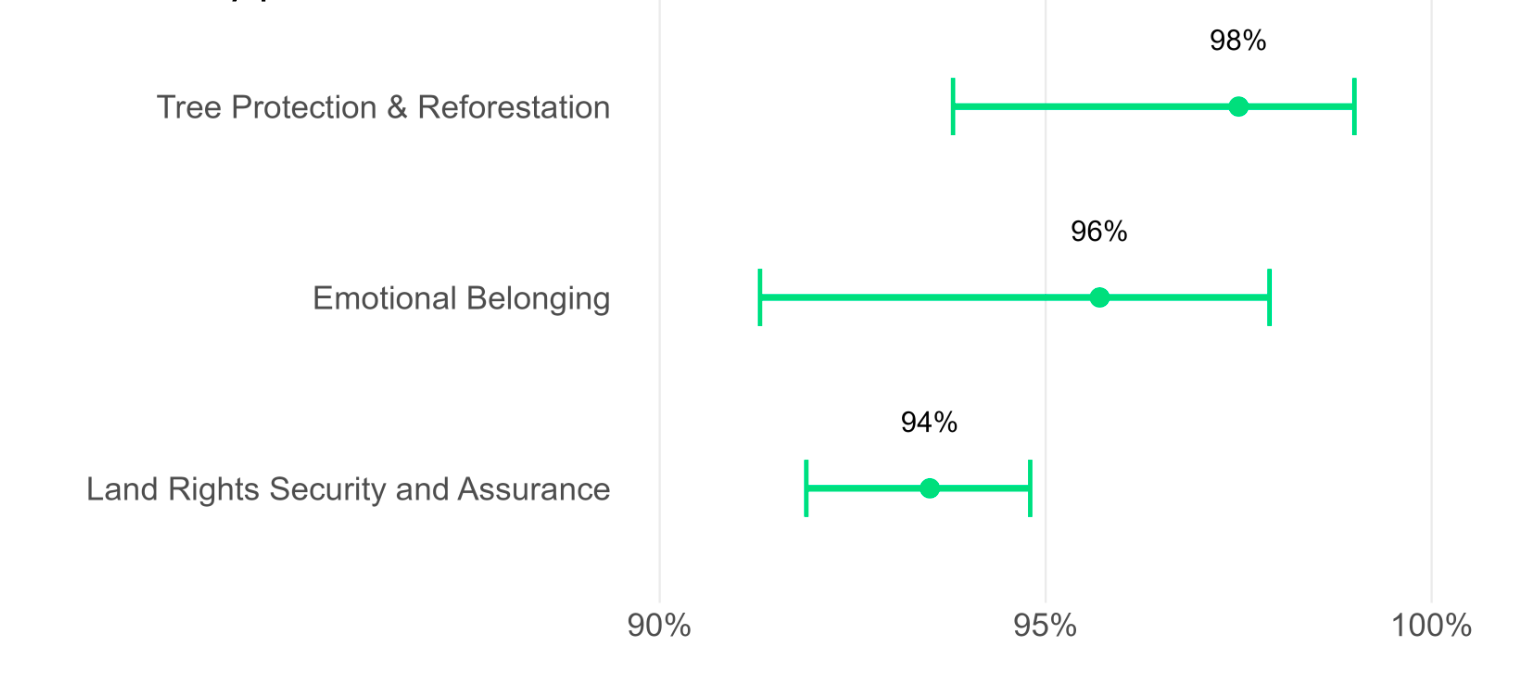
Key findings include:
- 94% report improved land rights security and assurance
- 96% report greater peace of mind, pride, and emotional belonging
These psychological and social effects consistently appear before any material economic gains.
What is emerging: Planning, inheritance, and inclusion
Beyond immediate security, the evaluation finds early but uneven progress.
Written documentation makes inheritance clearer and harder to contest, reducing disputes in many families: 85% report clearer inheritance arrangements.
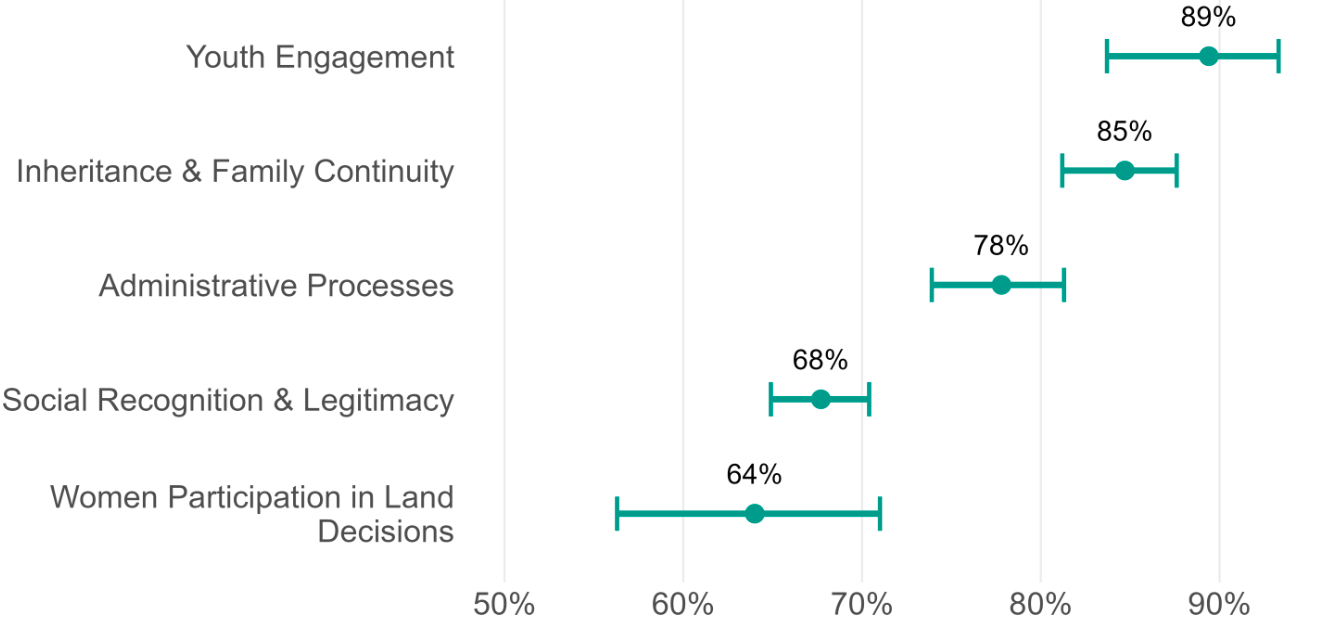
Youth show greater interest as future ownership becomes more concrete, and women are increasingly named on documents, particularly in joint certificates. At the same time, decision-making authority largely remains with elders and men. These shifts are real, but fragile, and depend on local and family dynamics.
What has not yet strongly materialised
Economic pathways remain weakly realised.
While land documents change how far ahead people are willing to plan, plans have not yet translated into widespread action.
In Côte d’Ivoire’s cocoa sector, this shift in planning horizon is particularly relevant. Many cocoa trees are ageing, and replanting is critical for the long-term future of production. Diversification and farm renewal can also serve as a lever for improving living income at the household level. The growing willingness to consider these steps is therefore significant, even if implementation remains limited so far.
So far, the data shows:
- 28% report early signs of investment or land development
- 8% report increased land value or compensation
- 1% report access to credit linked to land documents
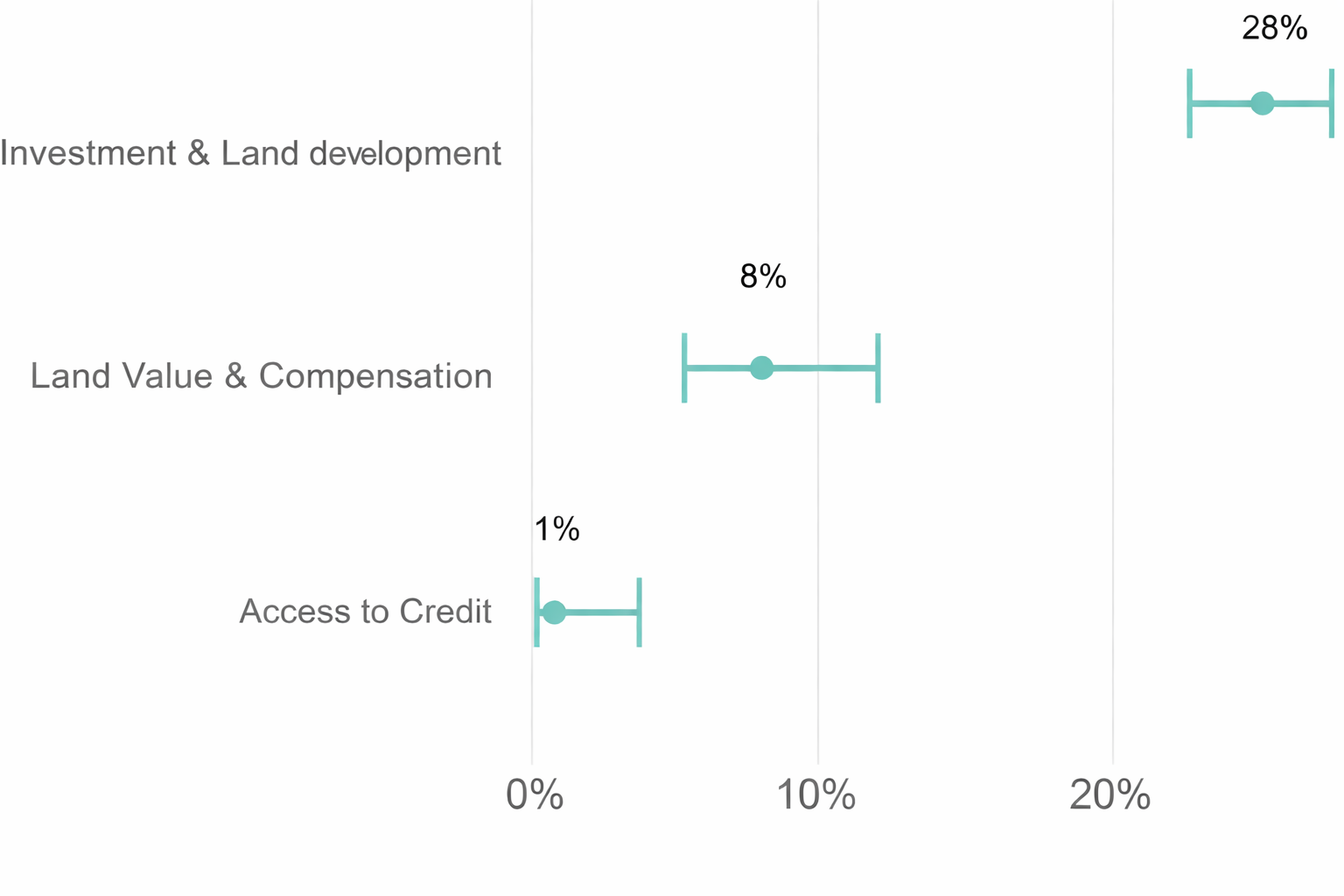
Nearly all participant groups hoped certificates would unlock bank loans. When this does not happen, frustration emerges. Managing expectations and aligning with financial institutions remains critical.
It is worth noting that the endline survey was conducted relatively shortly after document delivery, meaning there has been limited time for longer-term economic effects to unfold.
Key lessons from CLAP’s evaluation
- Security comes before income: Land documentation delivers immediate gains in peace of mind and social stability. Economic outcomes take longer and depend on additional enabling conditions.
- Visible boundaries make the difference: Joint demarcation and co-signing reduce disputes faster than paperwork alone and help turn uncertainty into everyday calm.
- Credit expectations must be managed: Most farmers expect land documents to unlock loans. When this does not happen, frustration follows. Clear communication and financial-sector alignment are critical.
Looking ahead
CLAP’s evaluation shows that land documentation can deliver meaningful early gains such as calmer communities, clearer expectations, and restored confidence, even before economic benefits materialise.
.png)