

As scrutiny of environmental impacts increases across global supply chains, two frameworks have emerged as critical: Deforestation- and Conversion-Free (DCF) commitments and the EU Deforestation Regulation (EUDR).
While they share similar objectives, they differ in scope, legal status and practical application. For companies navigating both, it is essential to understand how the frameworks align, where they diverge and how to prepare effectively.
This article explains the distinction, addresses common questions and provides practical guidance for sustainability and compliance teams.
What are deforestation- and conversion-free commitments?
DCF commitments are voluntary corporate policies that aim to eliminate deforestation and the conversion of natural ecosystems from supply chains. A company with a DCF policy pledges not to source commodities from land cleared or converted after a set cut-off date.
Key features
- Voluntary and often exceed legal requirements
- Cover deforestation and other forms of land conversion, including peatlands, savannahs and grasslands
- Apply globally, not limited to EU-bound products
- Based on environmental, reputational and ESG considerations
- Can be aligned with industry frameworks such as the Accountability Framework initiative (AFi)
What is the EU deforestation regulation?
The EUDR is a legally binding framework. It requires that certain commodities placed on or exported from the EU market are deforestation-free, legally produced and fully traceable.
The EUDR applies to
- Cocoa, coffee, palm oil, rubber, soy, wood, cattle, and their derivatives or embedded products.
- All operators and traders placing or exporting these products on and from the EU market
Core requirements
- Deforestation-free: no land deforested after 31 December 2020
- Legal: production must comply with applicable laws in the country of origin
- Traceable: plot-level geolocation data must be available for all production areas
- Due diligence: companies must assess, verify and mitigate any risk of non-compliance
The EUDR introduces enforceable obligations, and non-compliance may result in restrictions or penalties under EU law. Penalties may reach up to 4% of annual EU turnover.
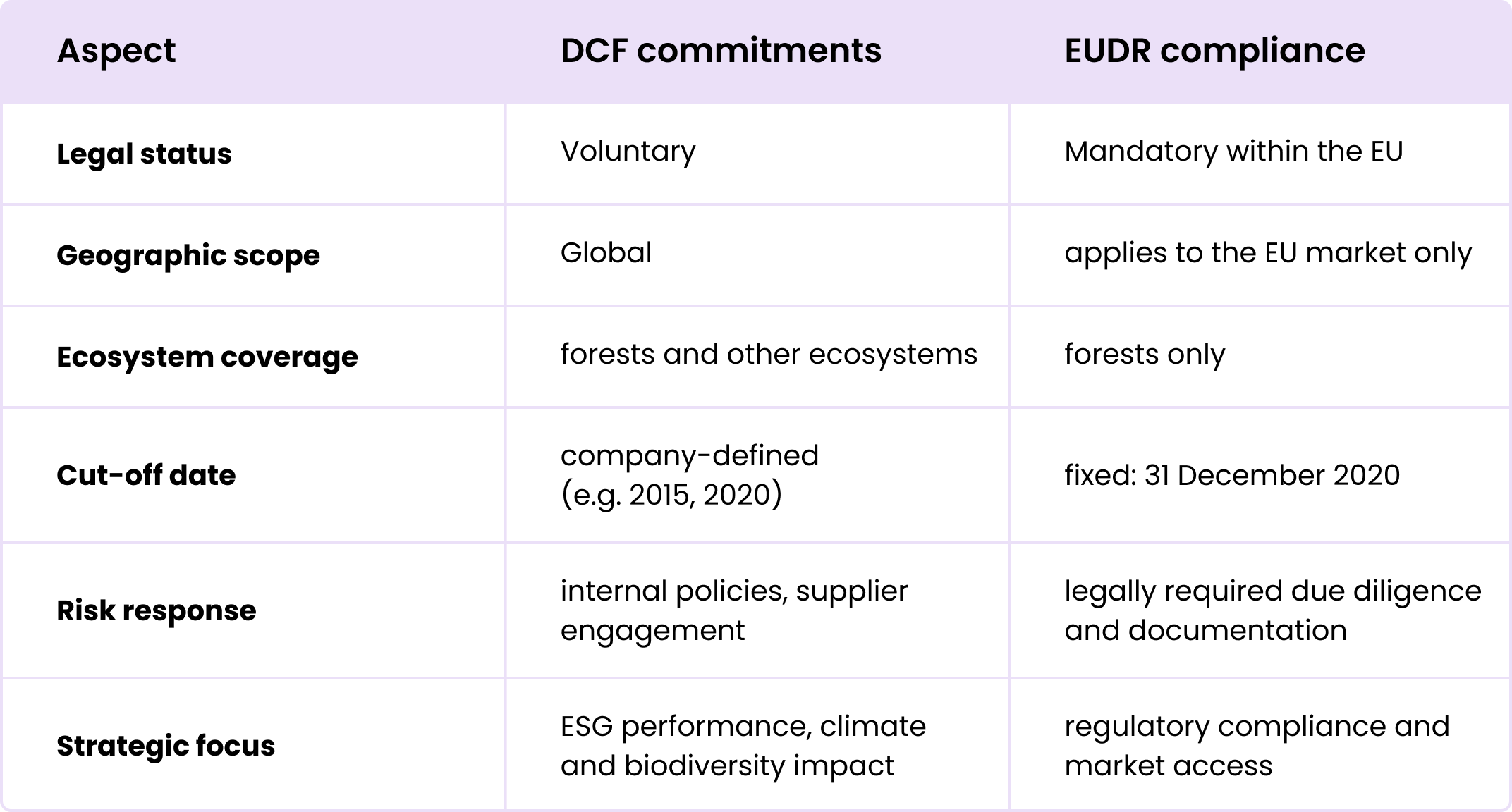
Does EUDR compliance equal meeting DCF commitments?
EUDR compliance and DCF commitments are not interchangeable. The EUDR provides a legal baseline for EU trade, while DCF commitments reflect broader environmental values and typically cover additional ecosystems and regions beyond the EU.
For example, while EUDR focuses only on forests, a DCF policy may include savannahs or wetlands. Furthermore, many DCF policies adopt earlier or more ambitious cut-off dates than EUDR. Companies with global sourcing networks or customers outside the EU often rely on DCF commitments to ensure a consistent and future-aligned approach.
Do DCF-aligned supply chains meet EUDR requirements?
Well-implemented DCF supply chains can meet EUDR criteria such as traceability and no-deforestation sourcing. However, even for companies with strong DCF policies, gaps remain in fully meeting the EU Deforestation Regulation’s (EUDR) legal and procedural requirements, notably in these areas:
- Due diligence challenges: While companies may have DCF policies, EUDR requires precise traceability to the plot level using validated geolocation data (preferably polygons). Achieving this level of detail is difficult, especially in fragmented supply chains with numerous smallholders lacking formal land titles or digital maps.
- Supplier engagement and compliance monitoring: ensuring that all suppliers, even indirect and smallholders, adhere to EUDR standards is complex. Companies must actively prevent the mixing of compliant and non-compliant commodities and maintain ongoing monitoring, often with limited control beyond first-tier suppliers.
- Data and risk assessment gaps: Companies may face difficulties harmonising multi-commodity, multi-region data and risk cut-off dates to avoid compliance loopholes. Scalable, credible, and transparent risk assessment incorporating both forest and non-forest ecosystems remains challenging.
- Administrative and reporting burden: Despite recent simplifications (e.g., annual due diligence statements instead of per shipment), the regulatory requirements for documentation, audit readiness, and record-keeping for at least five years remain substantial. Ensuring transparency, continuous improvement, and audit readiness demands sustained effort and resources.
- Regulatory complexity and legal uncertainties: With ongoing political debates and proposals to introduce a “very low-risk” country category, potentially weakening obligations, companies face uncertainty on future compliance frameworks and enforcement stringency that may impact their legal risk management strategies.
- Enforcement and penalties: Companies are exposed to high risks from significant fines (up to 4% of EU turnover), confiscation of products, and exclusion from procurement in cases of non-compliance, which may create hesitation or gaps in fully rigorous implementation.
Despite robust internal policies, the complexity of multi-tier supply chains, difficulties in precise geospatial validation, heavy compliance and reporting requirements, and evolving regulatory frameworks create persistent operational and legal gaps for companies aiming to meet EUDR standards comprehensively.
Practical steps to align DCF and EUDR
Define policy scope
Clearly define ecosystems covered, cut-off dates and expectations for suppliers. Make the policy public to support alignment and audit readiness.
Map supply chains
Collect geolocation data at the plot level using polygons rather than points. This improves the accuracy of spatial analysis, particularly near protected areas.
Clean and validate data
Ensure consistency and completeness across supplier records. Meridia provides services to clean, verify and structure large datasets.
Conduct risk assessments
Use satellite imagery, historical land-use data and proximity indicators to assess risk. This can be automated or semi-automated depending on scale.
Verify and document compliance
Maintain clear records of traceability, risk analysis, supplier communications and corrective actions.
Align systems and policies
If your DCF policy uses a stricter cut-off date or broader ecosystem scope, clarify where it applies and how it is enforced alongside EUDR.
Engage with service providers
Meridia supports real-time field data verification and (compliance) risk assessments to ensure compliance with both voluntary and regulatory frameworks.
The broader value of high-quality data
High-quality, farm-level data provides strategic value beyond compliance.
It enables:
- Forecasting yields based on plot size and location
- An accurate Scope 3 emissions calculation
- Targeted interventions in high-risk sourcing areas
- Improved ESG reporting and investor engagement
Aligning internal policies with external requirements
Understanding the difference between DCF commitments and EUDR obligations is essential for building ethical, sustainable supply chains. Both frameworks are important, and alignment strengthens long-term resilience.
Meridia supports companies in operationalising both EUDR compliance and DCF commitments through Meridia Verify’s risk assessment. These services enable supply chain traceability, support audit readiness and help businesses meet evolving sustainability expectations.
.png)
.png)
.png)