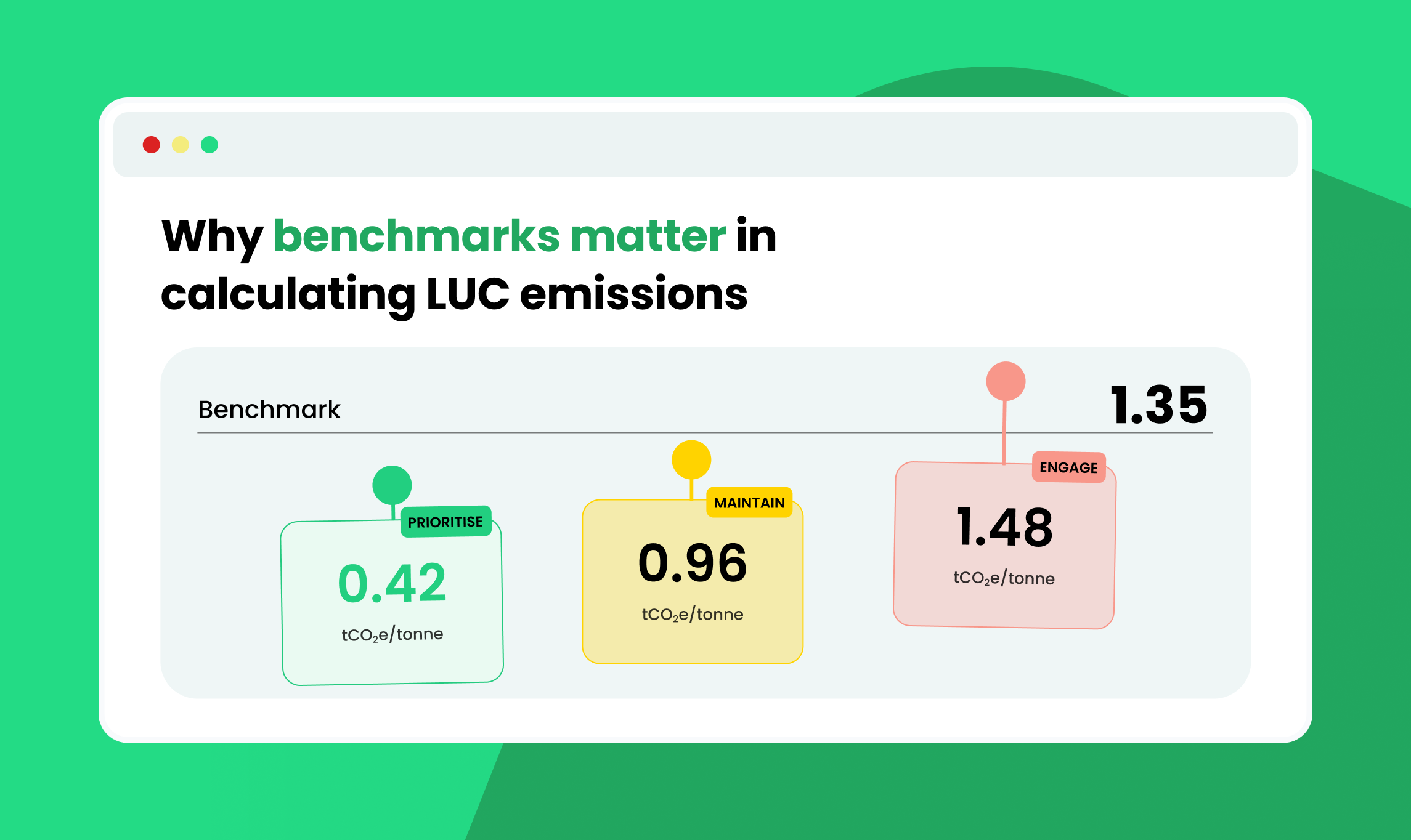
Using Meridia Verify to determine a farm-level emission factor is just one part of the story. Without the context of a regional benchmark, a business can’t understand whether this result means the supplier should be prioritised for remediation, or if it can be reasonably defended to an auditor. Learn more about Meridia Verify for scope 3.
Where the benchmark comes from
Verify arrives at a regional reference point by calculating jurisdictional direct land use change emissions (jdLUC). This means the emissions associated with the production of a commodity are estimated across a specific geography: whether that’s an entire country, a subnational sourcing area, or a defined production landscape.
By measuring the impact of the same crop, in the same region, with the same methodology, this gives emissions from an individual supplier a like-for-like point of comparison.
How the comparison is reported
By comparing the plot-level dLUC with the jurisdictional equivalent, Verify helps agricultural companies to determine how a specific supplier is matching, exceeding, or undercutting regional emissions rates associated with a commodity.
Where the supplier falls on the scale is reported as one of four categories which relate to relative performance: low, medium, high, or critical.
Verify also assigns each result a transparent quality rating, so teams can judge at a glance how reliable a given number is.
What to do with the answer
A low score confirms a supplier is associated with lower-than-average LUC emissions. It provides verifiable evidence to strengthen claims about sourcing sustainability, which can be shared in conversations with auditors and internal leaders, and used in public-facing reporting.
Where a result is above the benchmark – either returning a high or critical score – this supplier should be prioritised for engagement in order to mitigate their higher-than-average LUC emissions.
Why traceability matters
Importantly, whether an accurate score can be generated depends on the level of traceability your business has over its supply chain when it begins this analysis. If your emission factor is derived from a national average rather than farm polygons or a jurisdiction, it will be less precise.
As a result, changes in suppliers or remediation efforts that spark improvements in LUC emissions rates will not be reflected in your reported figures, because there’s no specific – not broad, country-level – baseline the improvement can be measured against. Only a methodology built on dLUC or jdLUC can register the effect of a particular sourcing decision.
How Meridia supports supplier benchmarking
The reliability of a supplier’s score against a benchmark is determined by how LUC emissions are calculated. Unlike statistical approaches which infer deforestation and conversion from country-wide trends, Verify looks at the reality on the ground through either granular farm-level data or a crop-specific jurisdictional lens.
What’s more, Verify’s methodology is fully documented. Every calculation approach, data source, and underlying assumption is disclosed, and updates are tracked through a versioned change log, so when a result shifts you can easily pinpoint why this has occurred.